Art Deco Clocks and Radios
Large French Art Deco Cobalt Blue Mirror and Nickel Clock by LANCEL Paris
Today Maison Lancel in Paris is known for high quality leather goods especially handbags, but in the 1930’s it produced the new “Automatic Lighter” and some of the most dazzling French art deco clocks. In 1929 they moved into the Place de L’Opera where this clock was produced. Constructed of cobalt blue mirror on a nickel plated bronze three step base, the clock is supported by columns of 17 hex shaped ridges. It is in excellent condition, the Swiss 8 Day movement keeps great time…and the alarm works too! The clock is 10 ¼” high x 15 ½” wide.
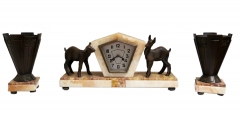
Japanese Art Deco Clock with Goldfish
A wonderful example of Japanese art deco design. This clock has six feet similar to a DominiqueDominique
[Founded in 1922]
Founded by Andre Domin (1883 - 1962) and Marcel Genevriere (1885 - 1976). Their showroom was located at 104 Faubourg, St. Honore. Their furniture design was characterized by simplicity and dignity.
One of Dominique's first commissions was to provide furniture for the home of silver designer Jean Puiforcat in Biarritz. This was followed by a commission to do the establishment of the perfumer Houbigant in Neuilly.
Beginning in 1926 they exhibited with Chareau, Legrain, Puiforcat and Raymond Templier as the "Groupe des Cinq".
Dominique exhibited a "Salon d'un Ambassadeur" at the 1925 Paris Exposition International des Arts Décoratifs et Industrieles Modernes. They also exhibited at the Exposition Colonial in Paris in 1931 and created a "Salon de Musique" for the 1937 Exposition Internationale des Arts et Techniques also in Paris.
For the great French ocean liner Normandie, launched in 1932, four luxury apartments were commissioned for each by a great French design firm (Leleu, Sue, Montagnac and Dominique). The Rouen suite which Dominique designed "was remarkable for the extremely refined use that Dominique made of materials...unquestionably the most avant-garde of the four talents assigned to the deluxe apartments". design and a black base with geometric frieze. The clock, which rests under a glass dome, has deco numbers and a rotating shaft, a red arrow which points to the time, two goldfish which “swim ” around the center shaft. The clock, ca. 1935, is marked on the bottom “National Clock Company, Japan”. It is 5 3/8 “ high, 4 ½ “ wide and 4” deep.
American Art Deco Detrola Super Pee Wee Radio
The rare American art deco Detrola “Super Pee - Wee” radio # 219 was designed in 1938 by George W. Walker (1896 - 1933) for the Detrola Company of Detroit Michigan. The case is bright red plaskon with a “Wrap Around” grill of Ivory with inclusions. The radio is 5” high, 8” wide and 5” deep.
Walter Dorwin Teague American Art Deco Sparton Bluebird Blue Mirror Radio
This American art deco radio was designed by Walter Dorwin Teague (1883 – 1960 ) for the Sparks – Worthington Company, Jackson Michigan and introduced in September 1935 for the 1936 model year, it was produced until 1940. The radio, known as the "Bluebird"; is model number 566 and is considered an icon to deco collectors. A 14" circle of mirrored cobalt blue glass intersected by chrome circles and three "speed" lines is centered with an illuminated tuning dial. The mirror rests on the two ebonized ball feet and hides the radio works. The radio is in excellent condition.
Walter Dorwin Teague American Art Deco Blue Mirror Sparton Radio
This American art deco radio was designed by Walter Dorwin Teague (1883 – 1960) for the Sparks-Worthington Company, Jackson, Michigan and introduced in 1936. It was produced until 1940. The radio, known as the “sled” is a marvel of art deco streamline style. Three ebonized wood bands on the left and five chromed bands on the right encase a body of cobalt blue mirror. The radio is 8 ¾” x 17 ½” x 8 3/8” and is in excellent condition.
F MARTIN French Art Deco Table or Mantel Clock
What a fantastic clock! This French art deco table or mantel clock is from the 1930’s. Constructed of polished brass and stainless steel with butterscotch and black marble on the base and top, the clock is by famed French clock maker F. Martin. The case is 15” tall, 17” wide and 5” deep. It is in excellent working condition.
Gilbert Rohde American Art Deco Burlwood Clock
A superb American art deco electric clock designed by Gilbert RohdeGilbert Rohde
American [1894 - 1944]
Gilbert Rohde was one of the pioneers of American Modern design.
Starting in the late 1920's, Rohde designed furniture for clients and his own furniture retailed by others.
In 1930 he designed a line of furniture for Heywood Wakefield and beginning in 1930 until 1944 he designed for Herman Miller Company, using a variety of new materials and techniques. While Rohde designed for several other furniture manufacturers his work for Herman Miller remains his best work and some of the best work of the period.
Rohde's designs for clocks for the Herman Miller Company and lamps for the Mutual Sunset Lamp Company are classics of the Art Deco era. (1896 – 1944) for the Herman Miller Company in 1933. The case is in Maidou burl veneer with white face, black hands, red second hand and three “speed” stripes. The clock is Number 4082-B in the company literature and was in the 1933 and 1937 catalogs and also in the special catalog for the 1934 Chicago World’s Fair. The face is marked “Herman Miller Clock Co., Zeeland, Mich, USA”. The clock is 13” wide x 6 ¾” high and 2 ½” deep.
FADA Plum & Butterscotch American Art Deco Catalin BULLET Radio
This streamline FADA “Bullet” model 1000 American art deco radio has a Catalin case of deep plum with golden butterscotch colored handle, knobs and dial ring. FADA coined the term “Fada-Lucent” to refer to their Catalin cabinets. The “Bullet” was produced from 1945 to 1948 and is the “most deco” of Catalin table top radios. The radio is 9 ¾” long, 6” high and 5 3/8” deep and is in excellent original condition.
CENTURY SIX MAJESTIC American Art Deco Radio
This American art deco table radio known as the “Majestic 463 Century Six” was marketed in honor of the 1933 World’s Fair, “Century of Progress”, held in Chicago, the home of the Grigsby-Gunrow Company who where the makers of the Majestic Radios. The radio features a cabinet of black walnut and lacewood and a polished chromium waterfall grill and escutcheon plate with three scalloped black rows. The raido is in exce;ptional condtion and is 12 ¾” tall, 13 ¼” wide and 9 ¼” deep.
DeWALD American Art Deco Catalin Radio
This unusual DeWALD American art deco radio, Model A 501, was produced from 1938 until World War II broke out. Its stylized lyre shape stands out as well as the “pinwheel” knobs. Cast in translucent yellow Catalin, now mellowed to a pleasing honey color, the radio is in excellent condition and has the desirable “herringbone” grill cloth. The radio is 9 ¾” long x 6 ¼” high and 5 ½” deep.
French Art Deco Round JAZ Clock in Brass
A fine French art deco table clock by the Compagnie Industrielle de Macanique Horelogere which used the trademark “JAZ” from 1919 to 1941. This clock is from a line of deco clocks that the company introduced in 1934. The circular brass clock frame encloses the floating numerals around a gold ground. The clock body swivels horozontically. The clock is 5-1/2” high and 4-1/2” wide. The clock is marked “JAZ” on the front and back an dis also marked on the back “modele depose, Made in France”.
Air King American Art Deco Radio
The Air King Model 52 radio is a true American art deco icon. John Sidel in his book "Classic Plastic Radios of the 30's and 40's" called it “one of the most important plastic radios ever made”. This black Air King Model 52 was designed by Harold Van Doren (1875- 1957) and John Gordon Rideout ( - 1951) for the Air King Products Company of New York in 1933. This early model constructed of Plaskon(an early plastic ), has the panel of Egyptian figures on its waterfall façade, making it extremely rare and desirable. The radio is 11 ¾” high, 8 ¾” wide and 6 ¾” deep.
FADA Yellow and Red American Art Deco Catalin BULLET Radio
This classic FADA “Bullet” radio, model 1000, is made of Catalin, a Phenolic resin often mistakenly called “Bakelite” (a brand name). In bright lemony yellow and marbleized cherry red, the radio with its sleek, rounded lines suggests speed and practicality. The ltters making up the company name are the initials of Frank Angelo D’Andrea who founded the company in the 1920’s. The radio is 9 ¾” long, 6” high and 5 3/8” deep and is in perfect original condition with a beautiful glossy finish.
KADETTE American Art Deco Catalin Radio CLOCKETTE Model
This incredible marbleized turquoise blue 1937 radio is made of catalin (a phenolic resin often incorrectly called Bakelite which is a brand name). The radio was manufactured by the Kadette Radio Corporation, Ann Arbor, Michigan and is known as the Kadette “Clockette” model K24. It features a brass dial face, matching knobs and its original decal. The radio is 8” tall, 8” wide and 5” deep and has been cosmetically restored/repaired to its original condition.
Gilbert Rohde American Art Deco Clock for the Herman Miller Company
Gilbert Rhode (1886 - 1958) designed this American art deco clock for the Herman Miller Company in the mid 1930s. The clock features a stepped chrome base, chrome frame and skyscraper hands. The clock is 6 and 1/2" tall, is in working condition and keeps excellent time.
Telechron American Art Deco Skyscraper Clock in Mint Green
This is the most famous “Paul FranklPaul Frankl
American [1886 - 1958]
Paul Frankl was the first American designer to produce a totally original American furniture design with his "Skyscraper" bookcases, the success of which led him to name his company "Skyscraper Furniture". Between his early (mid 1920's) success with "Skyscraper" style furniture and his later Chinese Modern and "Speed" furniture of the 1930's, Frankl wrote books and magazine articles on the Modern Style and was its most vocal proponent. He later designed production pieces for Brown & Saltzman of California and Johnson Furniture Company of Grand Rapids, incorporating an early use of biomorphic designs and novel materials such as cork veneer.” clock…that Paul Frankl had nothing to do with. Produced from about 1929 till 1931 this skyscraper styled American art deco table clock was made by the Warren Telechron Company. Known as the Model 700 and marketed as the “Electrolarm”, the clock came in three colors; walnut (brown Bakelite) and white or green “Vinylite” (Plaskon). Brown colors are the most common, green the rarest. The clock is 8” high and 6” wide at the base.
French Art Deco Silver over Bronze Clock
This spectacular French art deco silver over bronze clock dates from the 1930’s. The front features two lovebirds surrounded by abstract geometric flower designs. The numerals are picked out in bronze. The movement is by Japy Freres et Cie and strikes the hour and half hour. Standing 13 ½” tall and 10 ½” wide. This clock will be an important addition to any interior.
French Art Deco Desk Set with Clock
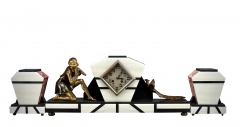
This handsome 1930s French art deco desk set is in black and white portero marble. Floating on three nickel ball feet, the demiune base has an indentation to hold pens and two round towers (originally inkwells) to capture paper clips and rubber bands. The towers have swivel nickel tops. The center contains a nickel trimmed clock. The clock, which keeps good time, is marked on the front “Satisfaction” and has an alarm function to remind you of appointments. The set measures 15 ½” wide, 9 ¼” deep and is 5 ¼” high.
French Art Deco Figural Clock
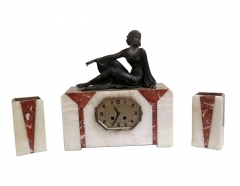
This large 1920’s French art deco clock features a bronze patinaed metal sculpture of Diana the Huntress with her ivory bow. Diana kneels on the white marble top of a black marble base with sloping ends and inlays of translucent green and brown onyx. Her stance is balanced by the sweep of the black marble back which holds the clock. The clock is set into a green onyx shield, has geometric numerals is key wind and strikes the hours. It is in working condition and the chime works. Overall, the piece measures 21 ½” high (to the top of the bow), 19 ½” wide and is 6” deep.
Paul Frankl American Art Deco Modernique Clock
In 1928-29, when Paul FranklPaul Frankl
American [1886 - 1958]
Paul Frankl was the first American designer to produce a totally original American furniture design with his "Skyscraper" bookcases, the success of which led him to name his company "Skyscraper Furniture". Between his early (mid 1920's) success with "Skyscraper" style furniture and his later Chinese Modern and "Speed" furniture of the 1930's, Frankl wrote books and magazine articles on the Modern Style and was its most vocal proponent. He later designed production pieces for Brown & Saltzman of California and Johnson Furniture Company of Grand Rapids, incorporating an early use of biomorphic designs and novel materials such as cork veneer. (1887 – 1958) designed this art deco clock for the Warren Telechron Co of Ashland Massachusetts, a good table clock sold for $4.95 to $6.95. Telechron introduced this clock, known as the “Modernique” at a retail price of $50.00. Because of the price and the 1929 market crash leading to the depression, very few were sold. The public didn’t call it the “Modernique” or the “Paul Frankl” clock, it became known as the “Fifty Dollar” clock. It is a special clock with its nickel plated brass body, black bakelite foot and brushed gold and silver “rays” delineating the hours. The clock works and keeps good time. The clock measures 7-3/4” high, 5-3/4” wide and 3-3/4” deep.