Art Deco Glass
A Set of Six Venetian Murano 1950’s Latticino Filigrana Juice Glasses
A set of six fine Venetian Murano juice glasses from the 1950’s. The glasses are decorated in a technique called "Latticino Filigrana Ribbon" with Ribbons of white Latticino bordered by gold and intersected with black lines. The 3 ½" tall glasses have an applied rim foot and are in excellent condition.
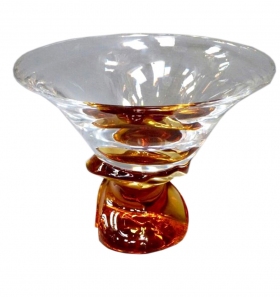
Charles Schneider Le Verre Francaise TORTUES French Art Deco Glass Bowl
This French art deco cameo glass bowl was created by Charles SchneiderCharles Schneider
[1881 - 1962]
In 1913, Charles Schneider and his brother established the Cristallerie Schneider at Epnay-sur-Seine, France. Charles had learned his trade as a designer for the great Art Nouveau glass firms of Galle and Daum.
Art glass by Schneider was originally signed Schneider, Le Verre Francaise, or Charder (a contraction of Charles Schneider). Occasionally, it was signed with the inclusion of a small candy-cane of striped glass in the base.
The glass marked "Schneider" was produced from 1913 to 1933 in a variety of shapes and colors, including a new deep orange, which Schneider developed in 1926 and called "Tango". This orange became so popular a color that it was copied in other mediums.
The glass that Schneider produced marked Le Verre Francais (the glass of France), and Charder, was made of two contrasting layers of colored glass. Part of the outer layer was cut away in various Art Deco motifs by acid etching, to reveal the lower layer.
At the famous 1925 Paris, France Exposition des Arts Decoratifs, from which Art Deco took its name, Schneider exhibited and caused a sensation. In 1926, he was awarded the French Legion of Honor. (1881 – 1953) for his Le Verre Francaise line. The low, waisted bowl is uncommon in his oeuvre. It is cut in the Tortues pattern in red and green on an orange Tango ground which was only produced from 1918 until 1921. It is signed with the Schneider candy cane set into the bottom. The bowl is 11" in diameter x 4" high.
American Art Deco Sterling Overlay Leaping Stag Ice Bucket
This American art deco ice bucket dates from the late 1920’s. Sterling silver on Cambridge black glass produces a floral and foliate design with an iconic Leaping Stag inside a center medallion. The silver band around the top rim supports a raffia covered handle. The bucket is 6” high and 5 ¼” in diameter at the top. It is in excellent original condition.
Eight American Art Deco BLUE MOON Cordial Cups by Chase Brass & Copper Company
A set of eight cordial cups designed by Harry Laylon for the Chase Brass & Copper Company in the “Blue Moon” pattern. The cups are # 90067 in the company literature and were available between 1936 – 1941. Each cup in cobalt blue glass and stepped chrome base is 3 ½” tall.
American Art Deco Bronze and Etched Glass Firescreen
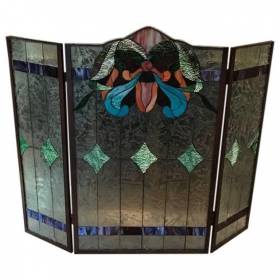
This American art deco firescreen has a bronze frame with asymmetric sides with a “Waterfall” décor. The frame sits on the four feet; the center two stepped, the outer two with a curved side flange. The ½” inch glass is etched with a fantastic creature amid swirls and geometric circles depicting the North Wind. The screen is 48” wide, 29 ½” high and 7” deep (at the feet).
American Art Deco Ruba Rombic Vase
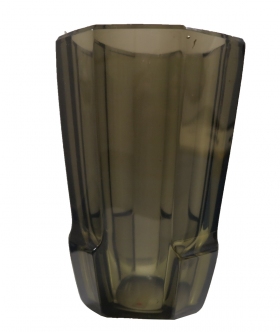
This American art deco Ruba Rombic vase was designed in 1927 by Reuben Haley (1872 – 1933) and introduced in 1928 by the Consolidated Lamp and Glass Company of Coraopolis, Pennsylvania. The Ruba Rombic line was only produced for four years, until 1933. The 9 ½” high vase is in Consolidated’s “silver” color.
French Art Deco Decanter Set
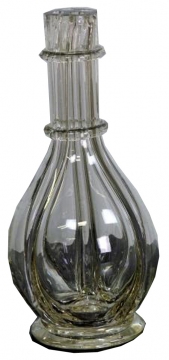
A French art deco decanter and six cordials in frosted and polished crystal glass. The decanter measures 11 ¾” high and the cordials 2 ¾” high each.
American Art Deco Glass Picture Frame
This American art deco free standing table picture frame is from the 1930’s. The beveled glass front is decorated with a simple silver line and is attached to the back by four glass rosettes. The 10" x 12" frame holds an 8" x 10" photo.
Kosta Boda Vase by Goran and Ann Warff
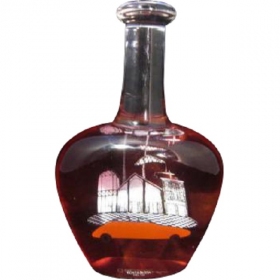
This striking glass vase was designed for Kosta Boda, Swedish glass maker in the 1960’s by Goran Warff (1933 - ) and Ann Warf (1937 - ). The thick walled blown glass vase is of light amber and colorless glass overlaid in pale rose. Heavy red glass has been applied to the front and worked in a relief design. The back has been polished to pass light. The polished base is etched “Kosta 47318 Warff”. The vase is 7 3/8” high and 5 ½” wide.
Benny Motzfeld Norwegian Glass Vase
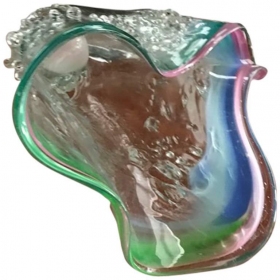
This sophicated norwegian glass vase was designed and made by Benny Motzfeld (1901 - 1995). She was called “Today the most collected Norwegian glass artist”. The blown waisted vase of colorless glass is internally decorated with gold inclusions and trapped bubbles and was made ca 1965. The polished pontil is acid stamped “plus”, “BM” and “Norway”. The vase is 4” high and 7” diameter.
Charles Schneider French Art Deco Vase with Inclusions
This French art deco glass vase is by master verrier Charles SchneiderCharles Schneider
[1881 - 1962]
In 1913, Charles Schneider and his brother established the Cristallerie Schneider at Epnay-sur-Seine, France. Charles had learned his trade as a designer for the great Art Nouveau glass firms of Galle and Daum.
Art glass by Schneider was originally signed Schneider, Le Verre Francaise, or Charder (a contraction of Charles Schneider). Occasionally, it was signed with the inclusion of a small candy-cane of striped glass in the base.
The glass marked "Schneider" was produced from 1913 to 1933 in a variety of shapes and colors, including a new deep orange, which Schneider developed in 1926 and called "Tango". This orange became so popular a color that it was copied in other mediums.
The glass that Schneider produced marked Le Verre Francais (the glass of France), and Charder, was made of two contrasting layers of colored glass. Part of the outer layer was cut away in various Art Deco motifs by acid etching, to reveal the lower layer.
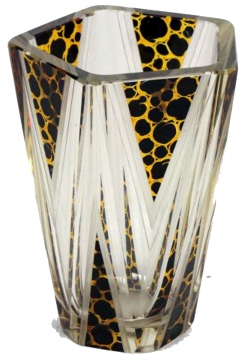
At the famous 1925 Paris, France Exposition des Arts Decoratifs, from which Art Deco took its name, Schneider exhibited and caused a sensation. In 1926, he was awarded the French Legion of Honor. (1881 – 1962) and was blown ca. 1930. The orange mottled glass has maroon powder inclusions in the shape of circles with dots in center and is overlaid with clear frosted glass. The vase is 12 ½” high and 11” in diameter.
French Art Deco Ice Bucket in the Style of Maurice Marinot
This lovely 1930's French art deco ice bucket is in the style of Maurice Marinot (1882 - 1960). The thick walled glass body internally decorated with random bubbles is punctuated by two applied lug handles. The bucket is 8" high and 7 1/2" in diameter (10" at the handles).
French Art Deco Acid Etched Geometric Design Yellow Glass Vase
This very geometric French art deco vase is of translucent yellow glass. The vase has four ribbed wings on each side and four acid etched bands circling the body, separated by speed lines. Standing 8 ¼” high and 6” in diameter, the vase is 7 ½” across at the wings.
Charles Schneider French Art Deco Cameo Glass Vase PRUNES
This French art deco cameo glass vase from the Barbra Streisand Collection was created by Charles SchneiderCharles Schneider
[1881 - 1962]
In 1913, Charles Schneider and his brother established the Cristallerie Schneider at Epnay-sur-Seine, France. Charles had learned his trade as a designer for the great Art Nouveau glass firms of Galle and Daum.
Art glass by Schneider was originally signed Schneider, Le Verre Francaise, or Charder (a contraction of Charles Schneider). Occasionally, it was signed with the inclusion of a small candy-cane of striped glass in the base.
The glass marked "Schneider" was produced from 1913 to 1933 in a variety of shapes and colors, including a new deep orange, which Schneider developed in 1926 and called "Tango". This orange became so popular a color that it was copied in other mediums.
The glass that Schneider produced marked Le Verre Francais (the glass of France), and Charder, was made of two contrasting layers of colored glass. Part of the outer layer was cut away in various Art Deco motifs by acid etching, to reveal the lower layer.
At the famous 1925 Paris, France Exposition des Arts Decoratifs, from which Art Deco took its name, Schneider exhibited and caused a sensation. In 1926, he was awarded the French Legion of Honor. (1881 – 1958) for his Le Verre Francais line. The vase, in the “Prunes” cutting, depicts plums in violet glass over and underlayer of translucent copper-red glass. The vase is 6 ¼” high and is incised on the base “Le Verre Francais”. It is also signed with the “Beringot” (a small tri colored candy cane inserted hot into the vessel that Schneider used from 1918 until 1922 to mark his pieces). The vas still has the special sticker from the 1994 Christie’s Auction.
Charles Schneider French Art Deco CHARDER FOUGERES Cameo Glass Vase
This impressive French art deco cameo glass vase was created by Charles SchneiderCharles Schneider
[1881 - 1962]
In 1913, Charles Schneider and his brother established the Cristallerie Schneider at Epnay-sur-Seine, France. Charles had learned his trade as a designer for the great Art Nouveau glass firms of Galle and Daum.
Art glass by Schneider was originally signed Schneider, Le Verre Francaise, or Charder (a contraction of Charles Schneider). Occasionally, it was signed with the inclusion of a small candy-cane of striped glass in the base.
The glass marked "Schneider" was produced from 1913 to 1933 in a variety of shapes and colors, including a new deep orange, which Schneider developed in 1926 and called "Tango". This orange became so popular a color that it was copied in other mediums.
The glass that Schneider produced marked Le Verre Francais (the glass of France), and Charder, was made of two contrasting layers of colored glass. Part of the outer layer was cut away in various Art Deco motifs by acid etching, to reveal the lower layer.
At the famous 1925 Paris, France Exposition des Arts Decoratifs, from which Art Deco took its name, Schneider exhibited and caused a sensation. In 1926, he was awarded the French Legion of Honor. (1881 – 1953) for his Le Verre Francais line. The vase, in the “Fougeres” cutting depicts geometric ferns in mottled orange, red and green glass over a mottle white underlayer. The tall (17 ½”) vase was produced in 1927 and 1928 and is signed in cameo “Charder” (a contraction of Charles and Schneider) and incised on the foot “Le Verre Francais”. It is acid stamped “France” on the bottom.
DEGUE French Art Deco Blue Cameo Glass Vase by Cazaux
This French art deco cameo glass vase was designed by Edouard Cazaux 1889 – 1974) ca. 1930 for “Verrerier d’Art DegueDegue
[1889 - 1974]
In 1928 Edouard Cazaux, (1889 - 1974), an artist, sculptor and ceramic designer joined forces with David Gueron, founder of Christalleries de Compiegne. The company was called "Verrerie d' art Degue". They opened a retail outlet in 1930 in Paris on Rue Druout which existed until 1939. The company participated in the decoration of the steamship Normandy, launched in 1935. Their glass was signed "Degue".”. A shimmering blue translucent glass is acid cut in a geometric pattern to reveal the lower layer of textured and frosted colorless glass. In 1926 David Gueron, who owned “Cristalleries de Compiègne, entered the art glass business and named his business “Verrerie d’Art Degue”. In 1928 Cazaux joined him and designed special pieces with strong deco and geometric themes…this is one of those pieces. The 10” high vase is signed in cameo “Degue”.
Large French Art Deco DEGUE Violet Cameo Glass Vase by Cazaux
This large French art deco cameo glass vase was designed by Edouard Cazaux (1889 – 1974) ca. 1930 for “Verrerie d’Art DegueDegue
[1889 - 1974]
In 1928 Edouard Cazaux, (1889 - 1974), an artist, sculptor and ceramic designer joined forces with David Gueron, founder of Christalleries de Compiegne. The company was called "Verrerie d' art Degue". They opened a retail outlet in 1930 in Paris on Rue Druout which existed until 1939. The company participated in the decoration of the steamship Normandy, launched in 1935. Their glass was signed "Degue".”. A lovely violet translucent glass is acid cut in a geometric pattern to reveal the lower layer of frosted colorless glass. In 1926 David Gueron who owned “Cristalleries de Campaigne” entered the art glass business and named his company “Verrerie d’Art Degue”. In 1928 Cazaux joined him and designed special pieces with strong deco and geometric themes….this is one of those pieces. The 14 ¾” tall vase is signed in Cameo “Degue”
Charles Schneider French Art Deco CHARDER ROSACES Cameo Glass Vase Le Verre
This exciting French art deco cameo glass vase was created by Charles SchneiderCharles Schneider
[1881 - 1962]
In 1913, Charles Schneider and his brother established the Cristallerie Schneider at Epnay-sur-Seine, France. Charles had learned his trade as a designer for the great Art Nouveau glass firms of Galle and Daum.
Art glass by Schneider was originally signed Schneider, Le Verre Francaise, or Charder (a contraction of Charles Schneider). Occasionally, it was signed with the inclusion of a small candy-cane of striped glass in the base.
The glass marked "Schneider" was produced from 1913 to 1933 in a variety of shapes and colors, including a new deep orange, which Schneider developed in 1926 and called "Tango". This orange became so popular a color that it was copied in other mediums.
The glass that Schneider produced marked Le Verre Francais (the glass of France), and Charder, was made of two contrasting layers of colored glass. Part of the outer layer was cut away in various Art Deco motifs by acid etching, to reveal the lower layer.
At the famous 1925 Paris, France Exposition des Arts Decoratifs, from which Art Deco took its name, Schneider exhibited and caused a sensation. In 1926, he was awarded the French Legion of Honor. (1881 – 1953) for his Le Verre Francais line. The vase, in the “Rosaces” cutting, depicts geometric flower heads against vertical lines in red to violet glass over a mottled orange and red glass base. The exceptionally tall (23” high) vase was produced in 1927 and 1928 and is signed in cameo “Charder” (a contraction of Charles and Schneider) and incised on the foot “Le Verre Francais”. It is acid stamped “France” on the bottom.
DAUM French Art Deco Cameo Glass Vase
This striking French art deco cameo glass vase is by the Daum firm of Nancy. The upper layer of orange yellow glass is acid etched to reveal the orange lower layer and create a design of geometric chrysanthemums in bloom. In addition to the color contrast, the upper layer is highly polished while the lower layer has a mat textural finish. The vase is signed on the base “Daum Nancy, France” with the Cross of Lorraine and it measures 7 1/2” high.
Degue French Art Deco Cameo Glass Vase
This French art deco cameo glass vase was designed by David Gueron for his own company "Verre d'Art DegueDegue
[1889 - 1974]
In 1928 Edouard Cazaux, (1889 - 1974), an artist, sculptor and ceramic designer joined forces with David Gueron, founder of Christalleries de Compiegne. The company was called "Verrerie d' art Degue". They opened a retail outlet in 1930 in Paris on Rue Druout which existed until 1939. The company participated in the decoration of the steamship Normandy, launched in 1935. Their glass was signed "Degue".", known as "Degue". The company, founded in 1926, lasted only until 1939 when Gueron closed the factory and fled the Nazis. The mouth blown spherical vase sits on a cushion foot. The frosted white glass ground is overlaid with deep purple glass on the foot to a brillian reddish orange glass above. The upper layer is acid etched away to create a field of stylized tulips. The vase is signed "Degue" and "Made in France". The vase measures 9 1/4" high and 8" in diameter.