Degue

[1889 - 1974] 

In 1928 Edouard Cazaux, (1889 - 1974), an artist, sculptor and ceramic designer joined forces with David Gueron, founder of Christalleries de Compiegne. The company was called "Verrerie d' art Degue". They opened a retail outlet in 1930 in Paris on Rue Druout which existed until 1939. The company participated in the decoration of the steamship Normandy, launched in 1935. Their glass was signed "Degue".

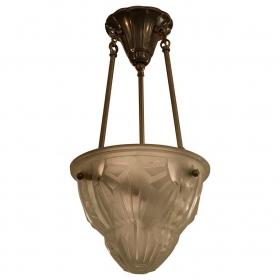
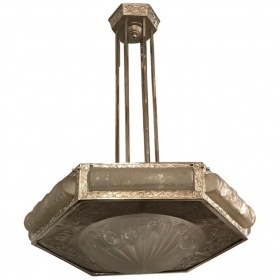
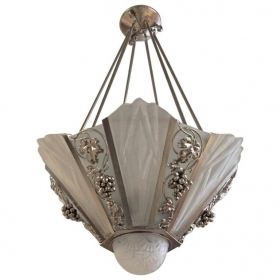
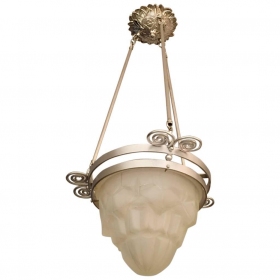
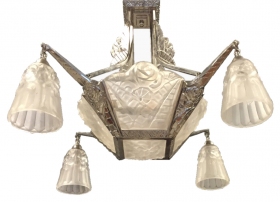
Degue French Art Deco Frosted Glass Ceiling Light with Roses

This French art deco ceiling light was designed by David Gueron for his firm “Verriere D’art DegueDegue
[1889 - 1974] 

In 1928 Edouard Cazaux, (1889 - 1974), an artist, sculptor and ceramic designer joined forces with David Gueron, founder of Christalleries de Compiegne. The company was called "Verrerie d' art Degue". They opened a retail outlet in 1930 in Paris on Rue Druout which existed until 1939. The company participated in the decoration of the steamship Normandy, launched in 1935. Their glass was signed "Degue".
” in Paris. Gueron opened his workshop in 1926 and closed it in 1939 in advance of the German invasion. The light, from the 1930’s has its original brass chain and ceiling cap. The frosted glass shade is molded in a geometric floral and leaf décor. The light is 14” in diameter and drops 15” from the ceiling.

DEGUE French Art Deco Blue Cameo Glass Vase by Cazaux

This French art deco cameo glass vase was designed by Edouard Cazaux 1889 – 1974) ca. 1930 for “Verrerier d’Art DegueDegue
[1889 - 1974] 

In 1928 Edouard Cazaux, (1889 - 1974), an artist, sculptor and ceramic designer joined forces with David Gueron, founder of Christalleries de Compiegne. The company was called "Verrerie d' art Degue". They opened a retail outlet in 1930 in Paris on Rue Druout which existed until 1939. The company participated in the decoration of the steamship Normandy, launched in 1935. Their glass was signed "Degue".
”.  A shimmering blue translucent glass is acid cut in a geometric pattern to reveal the lower layer of textured and frosted colorless glass.  In 1926 David Gueron, who owned “Cristalleries de Compiègne, entered the art glass business and named his business “Verrerie d’Art Degue”.  In 1928 Cazaux joined him and designed special pieces with strong deco and geometric themes…this is one of those pieces.  The 10” high vase is signed in cameo “Degue”.

Large French Art Deco DEGUE Violet Cameo Glass Vase by Cazaux

This large French art deco cameo glass vase was designed by Edouard Cazaux (1889 – 1974) ca. 1930 for “Verrerie d’Art DegueDegue
[1889 - 1974] 

In 1928 Edouard Cazaux, (1889 - 1974), an artist, sculptor and ceramic designer joined forces with David Gueron, founder of Christalleries de Compiegne. The company was called "Verrerie d' art Degue". They opened a retail outlet in 1930 in Paris on Rue Druout which existed until 1939. The company participated in the decoration of the steamship Normandy, launched in 1935. Their glass was signed "Degue".
”.  A lovely violet translucent glass is acid cut in a geometric pattern to reveal the lower layer of frosted colorless glass.  In 1926 David Gueron who owned “Cristalleries de Campaigne” entered the art glass business and named his company “Verrerie d’Art Degue”.  In 1928 Cazaux joined him and designed special pieces with strong deco and geometric themes….this is one of those pieces.  The 14 ¾” tall vase is signed in Cameo “Degue”

Degue French Art Deco Cameo Glass Vase

This French art deco cameo glass vase was designed by David Gueron for his own company "Verre d'Art DegueDegue
[1889 - 1974] 

In 1928 Edouard Cazaux, (1889 - 1974), an artist, sculptor and ceramic designer joined forces with David Gueron, founder of Christalleries de Compiegne. The company was called "Verrerie d' art Degue". They opened a retail outlet in 1930 in Paris on Rue Druout which existed until 1939. The company participated in the decoration of the steamship Normandy, launched in 1935. Their glass was signed "Degue".
", known as "Degue".  The company, founded in 1926, lasted only until 1939 when Gueron closed the factory and fled the Nazis.  The mouth blown spherical vase sits on a cushion foot.  The frosted white glass ground is overlaid with deep purple glass on the foot to a brillian reddish orange glass above.  The upper layer is acid etched away to create a field of stylized tulips.   The vase is signed "Degue" and "Made in France".  The vase measures 9 1/4" high and 8" in diameter.

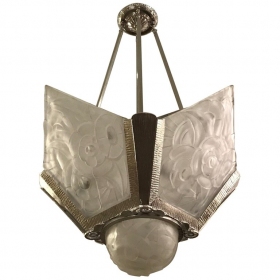
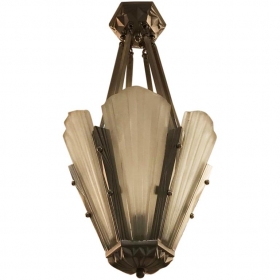
Degue French Art Deco Geometric Four Arm Chandelier

This 1930’s French art deco chandelier is by and designed by (1889 – 1974).  The nickeled metal body supports four large frosted glass “shields” and four curved arms, each hold frosted glass shades.  The geometrically formed glass with its “curtain wave” pattern contrast with the square tubing of the body.  The chandelier is 30” in diameter and drops 36” from the ceiling (the drop can be shortened according to need).  Rewired for American electricity.

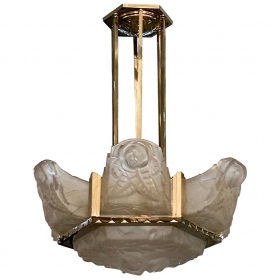
Degue Three Shade Chandelier

This French art deco chandelier features a combination of high quality wrought iron and the best of DegueDegue
[1889 - 1974] 

In 1928 Edouard Cazaux, (1889 - 1974), an artist, sculptor and ceramic designer joined forces with David Gueron, founder of Christalleries de Compiegne. The company was called "Verrerie d' art Degue". They opened a retail outlet in 1930 in Paris on Rue Druout which existed until 1939. The company participated in the decoration of the steamship Normandy, launched in 1935. Their glass was signed "Degue".
glass. The wrought iron is finely detailed and supports a thick glass center bowl and three matching shades, all executed in a dynamic swirling geometric roses patern and all signed “Degue”. The fixture drops 36” from the ceiling and is 30” in diameter.

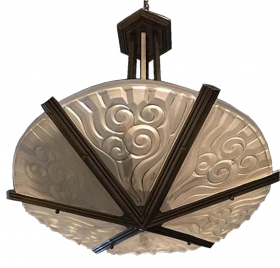
Degue Roses Chandelier

This is a wonderful French art deco ceiling fixture. The wrought iron body is hammered and bent into scallops, waves, circles and crosshatching. Dating from the 1930's, the molded glass is signed DegueDegue
[1889 - 1974] 

In 1928 Edouard Cazaux, (1889 - 1974), an artist, sculptor and ceramic designer joined forces with David Gueron, founder of Christalleries de Compiegne. The company was called "Verrerie d' art Degue". They opened a retail outlet in 1930 in Paris on Rue Druout which existed until 1939. The company participated in the decoration of the steamship Normandy, launched in 1935. Their glass was signed "Degue".
and depicts geometric roses and leaves. Dropping 36" from the ceiling and measuring 22" on each side, the fixture has been rewired for American electricity.

French Art Deco Geometric Glass & Pewter Chandelier by Degue

This very geometric French art deco chandelier dates from the 1930's and has four shades and a large center bowl, all signed "DegueDegue
[1889 - 1974] 

In 1928 Edouard Cazaux, (1889 - 1974), an artist, sculptor and ceramic designer joined forces with David Gueron, founder of Christalleries de Compiegne. The company was called "Verrerie d' art Degue". They opened a retail outlet in 1930 in Paris on Rue Druout which existed until 1939. The company participated in the decoration of the steamship Normandy, launched in 1935. Their glass was signed "Degue".
". The hand wrought iron body has been polished to its natural pewter color and sprayed with clear lacquer to keep it from turning. The fixture has been rewired for American electricity. The fixture drops 38" from the ceiling and measures 30" in diameter.

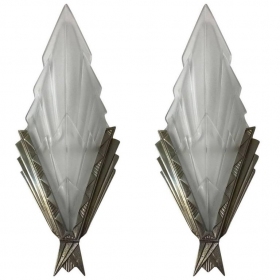
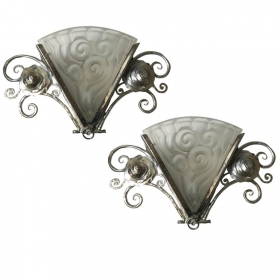
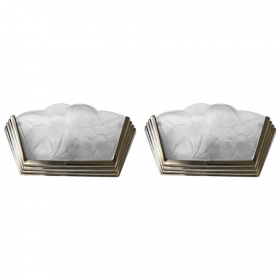
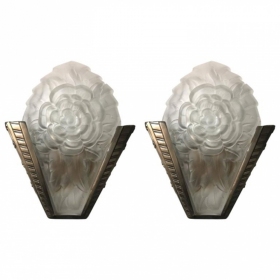
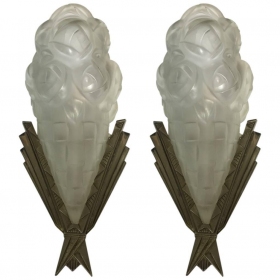
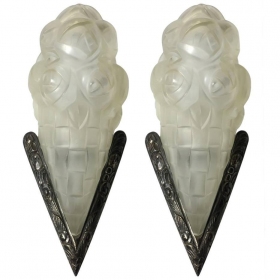
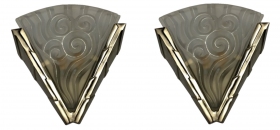
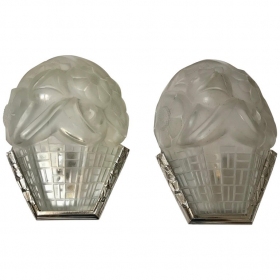
Degue Sconce

This French art deco wall sconce dates from the 1930s and was designed by Edouard Cazaux (1889-1974) for Les Cristalleries de Compiegne (DegueDegue
[1889 - 1974] 

In 1928 Edouard Cazaux, (1889 - 1974), an artist, sculptor and ceramic designer joined forces with David Gueron, founder of Christalleries de Compiegne. The company was called "Verrerie d' art Degue". They opened a retail outlet in 1930 in Paris on Rue Druout which existed until 1939. The company participated in the decoration of the steamship Normandy, launched in 1935. Their glass was signed "Degue".
) for whom Cazaux was artistic director from 1928 to 1935. The glass, which is in the form of geometric flowers set in a basket is signed "Degue" and is set in a nickel frame. The fixture measures 12" high by 10" wide and extends 4" from the wall.

French Art Deco Wrought Iron Torchiere with DEGUE Shade

This striking French art deco torchiere is from the 1930’s.  Constructed of hand wrought iron, the lamp is in true “machine age” style and equal in quality to the “master ferronieres” of the period with exposed rivets, a collar on the upper shaft all set on a curving tripod foot.  The three lobed “pate d’verre” shade ranges from purple to orange to yellow and is signed “DegueDegue
[1889 - 1974] 

In 1928 Edouard Cazaux, (1889 - 1974), an artist, sculptor and ceramic designer joined forces with David Gueron, founder of Christalleries de Compiegne. The company was called "Verrerie d' art Degue". They opened a retail outlet in 1930 in Paris on Rue Druout which existed until 1939. The company participated in the decoration of the steamship Normandy, launched in 1935. Their glass was signed "Degue".
” on the glass.  When lighted, the glass emits a bright sunrise/sunset hue.  It is 16” wide at the top and is 72” high.  In excellent condition, the torchiere has been rewired to American electricity.

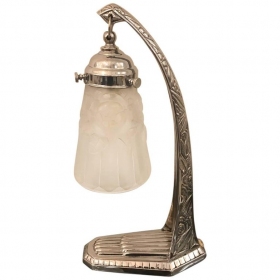
Degue Table Lamp

A French art deco table lamp from the 1930's, this fixture has a flat base resting on four ball feet with four decorative balls and a thin shaft, all bright nickel. The peach pagoda shaped glass shade is signed DegueDegue
[1889 - 1974] 

In 1928 Edouard Cazaux, (1889 - 1974), an artist, sculptor and ceramic designer joined forces with David Gueron, founder of Christalleries de Compiegne. The company was called "Verrerie d' art Degue". They opened a retail outlet in 1930 in Paris on Rue Druout which existed until 1939. The company participated in the decoration of the steamship Normandy, launched in 1935. Their glass was signed "Degue".
. The lamp has been rewired for American electricity but retains its original white plastic on/off button. Measures 17" high.

site : © Alaskan Star Interactive